Visual Corner

AI-first visual collections: architecture diagrams, frameworks, decision trees, and reusable patterns for enterprise AI systems.

AI-generated + curated visuals

Filter by Category

Filter by Tags

Showing 8 of 8 visual collections

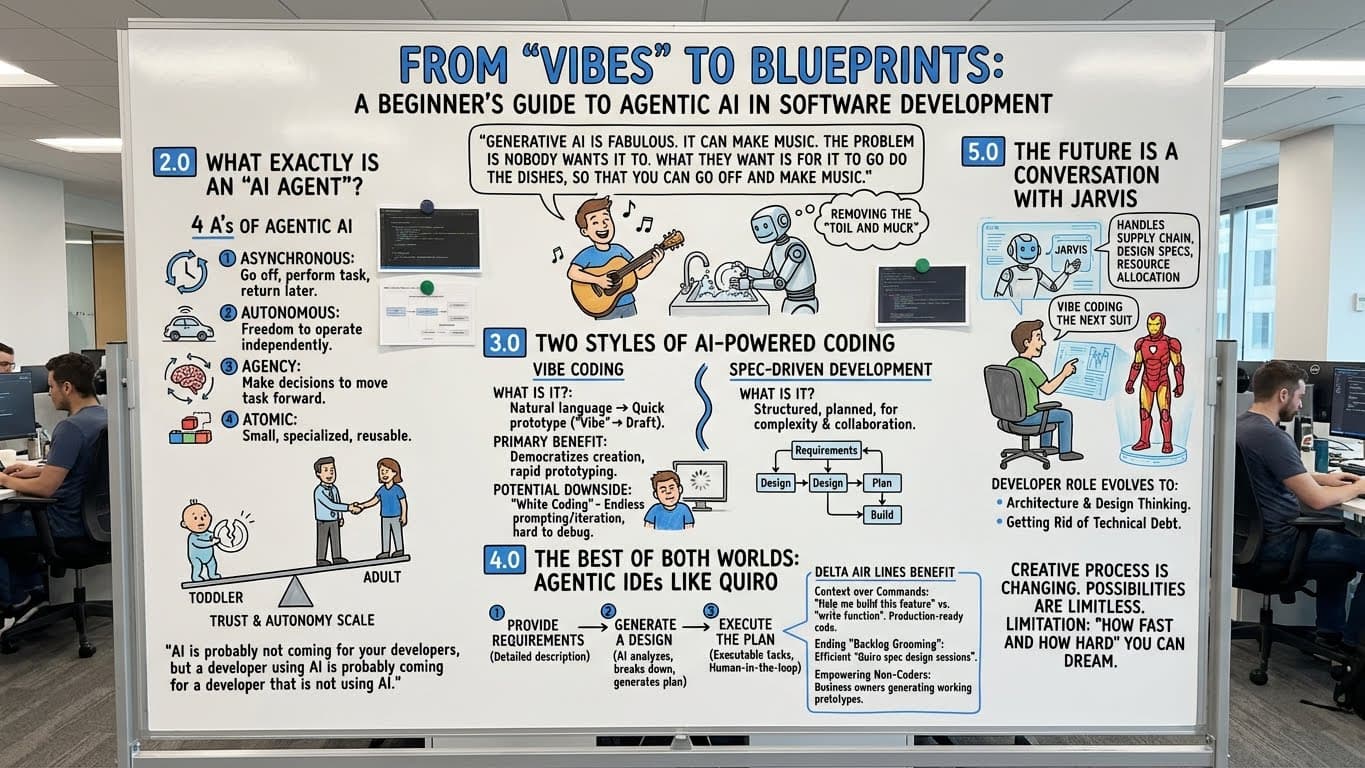
Whiteboard guide showing: 1) What is an AI agent (4 A's: asynchronous, autonomous, agency, atomic), 2) Two AI-powered coding styles (vibe coding for quick prototypes vs spec-driven development for structured complexity), 3) Best of both worlds with agentic IDEs like Quiro (provide requirements, generate design, execute plan), 4) Future conversation with Jarvis handling supply chain, design specs, resource allocation, and vibe coding the next suit
Whiteboards

From Vibes to Blueprints: Agentic AI in Software Development

A beginner's guide to agentic AI for software developers, contrasting 'vibe coding' (natural language prototyping) with spec-driven development (structured planning for complexity). Explains the 4 A's of agentic AI, two development styles, and how agentic IDEs like Quiro combine requirements, design, and execution.
AgentsProduct/UIAI Architecture
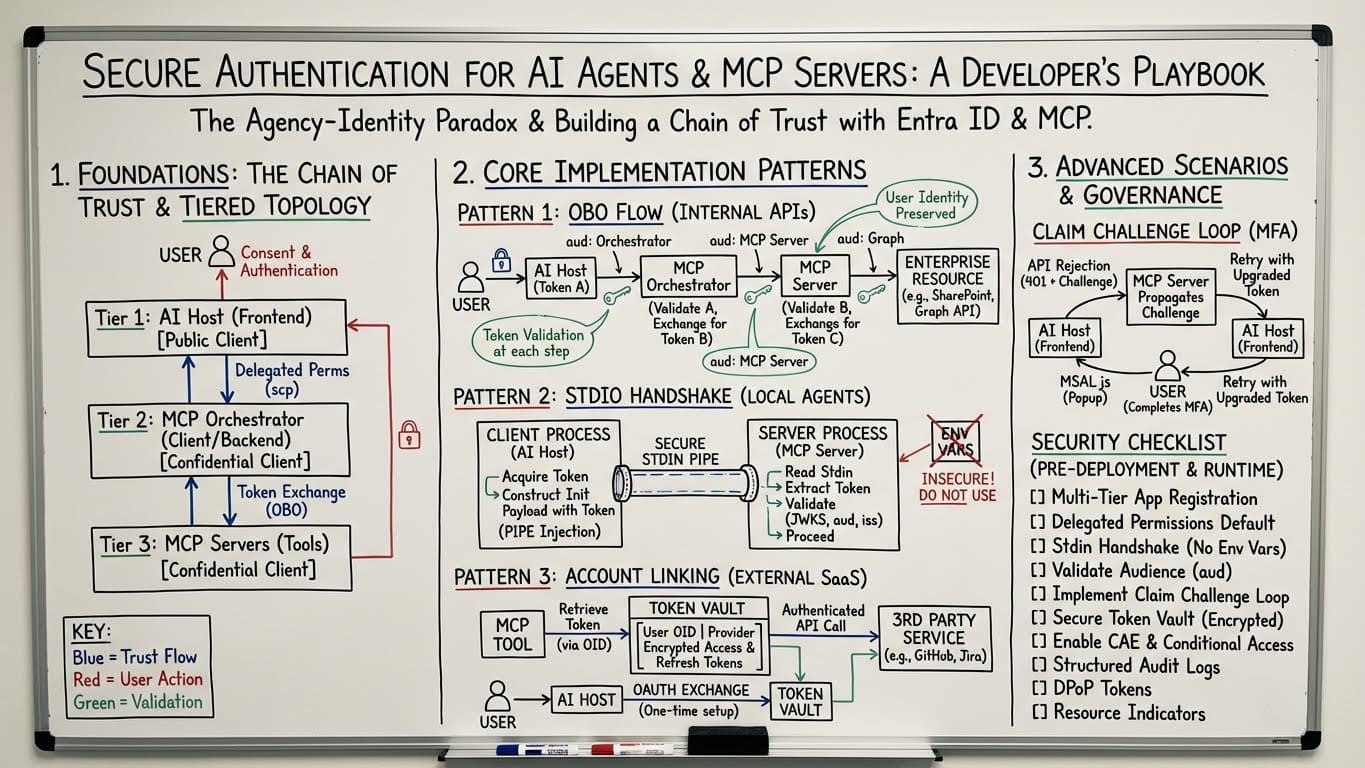
Technical whiteboard showing: 1) Foundations with chain of trust and tiered topology (user → AI host → MCP orchestrator → MCP servers), 2) Core implementation patterns (OBO flow for internal APIs, STDIO handshake for local agents, account linking for external SaaS), 3) Advanced scenarios with claim challenge loop for MFA, and 4) Security checklist for pre-deployment and runtime with 10+ security controls
Whiteboards

Secure Authentication for AI Agents & MCP Servers

A developer's playbook for implementing secure authentication in AI agent and MCP server architectures. Covers the agency-identity paradox, tiered trust topology, core implementation patterns (OBO flow, STDIO handshake, account linking), advanced scenarios (claim challenge loop for MFA), and comprehensive security checklist.
Security/IAMAgentsMCP+1
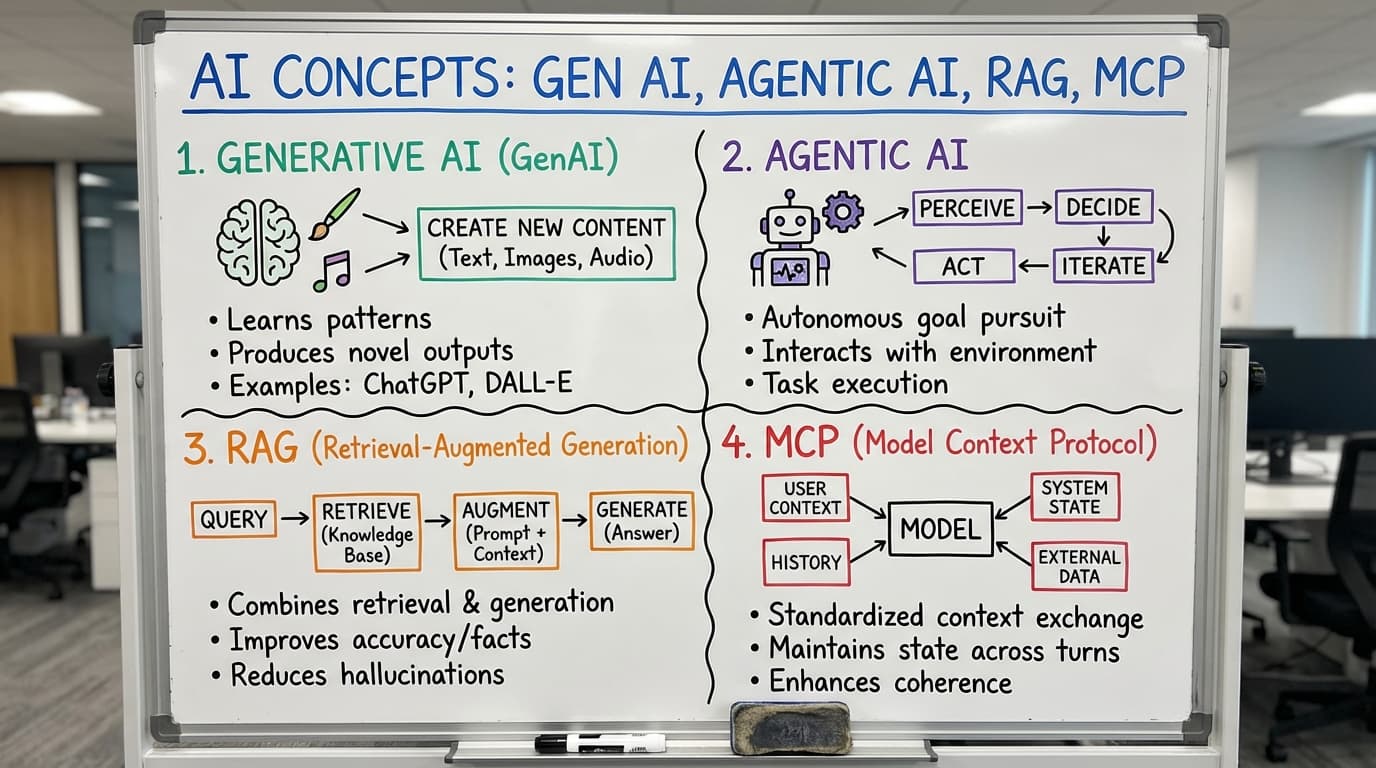
Whiteboard diagram showing four AI concepts: Generative AI (creates new content), Agentic AI (autonomous goal pursuit with perceive-decide-act loop), RAG (retrieval-augmented generation workflow), and MCP (Model Context Protocol with user context, history, system state, and external data)
Whiteboards

AI Concepts: GenAI, Agentic AI, RAG, and MCP

A comprehensive whiteboard overview of four critical AI concepts every practitioner should understand: Generative AI for content creation, Agentic AI for autonomous goal pursuit, RAG for accurate retrieval-augmented generation, and MCP for standardized context management.
AI ArchitectureRAGAgents+1
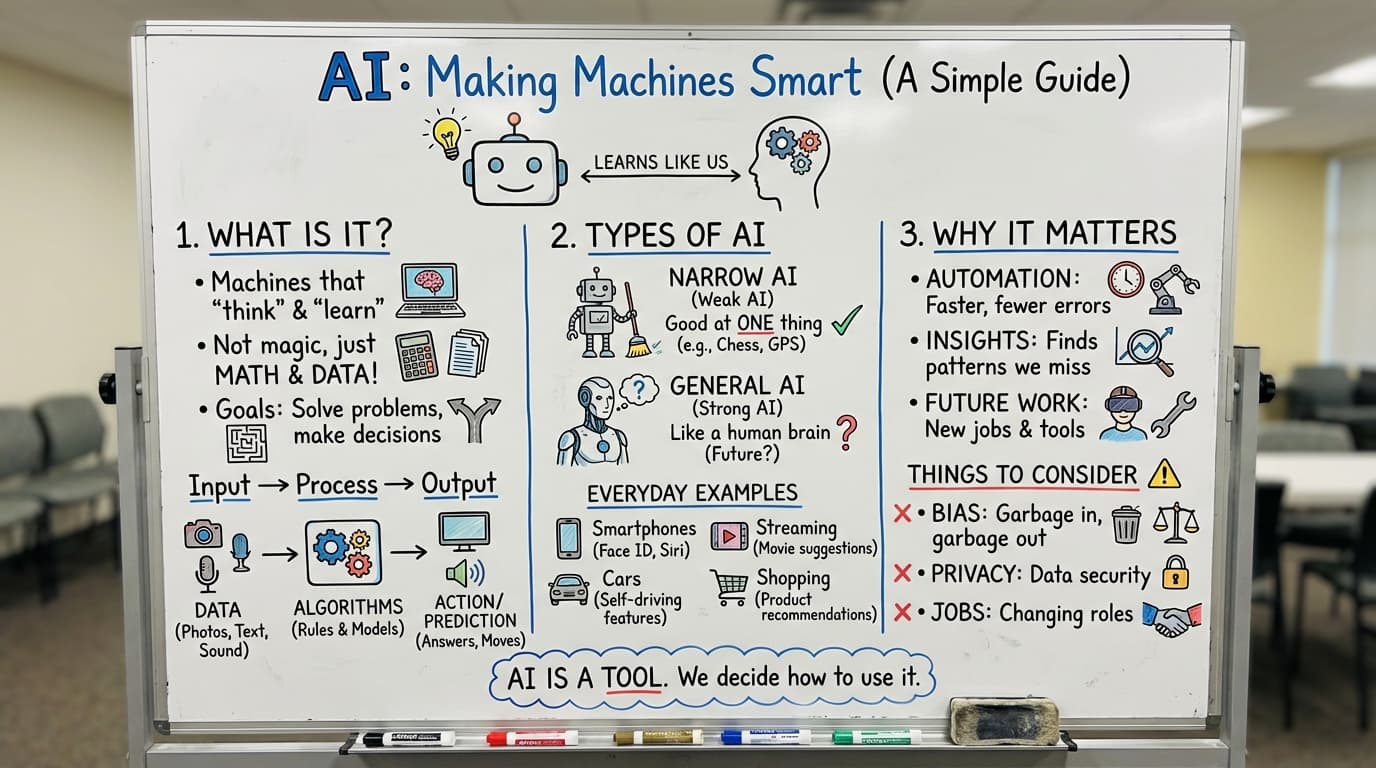
Infographic showing AI fundamentals: what it is (machines that think and learn), types of AI (narrow vs general), and why it matters (automation, insights, future work), plus key considerations like bias, privacy, and jobs
Infographics

AI Fundamentals: Making Machines Smart

A beginner-friendly visual guide explaining what AI is, the different types of AI (Narrow vs General), and why it matters for automation, insights, and the future of work. Covers key considerations around bias, privacy, and changing job roles.
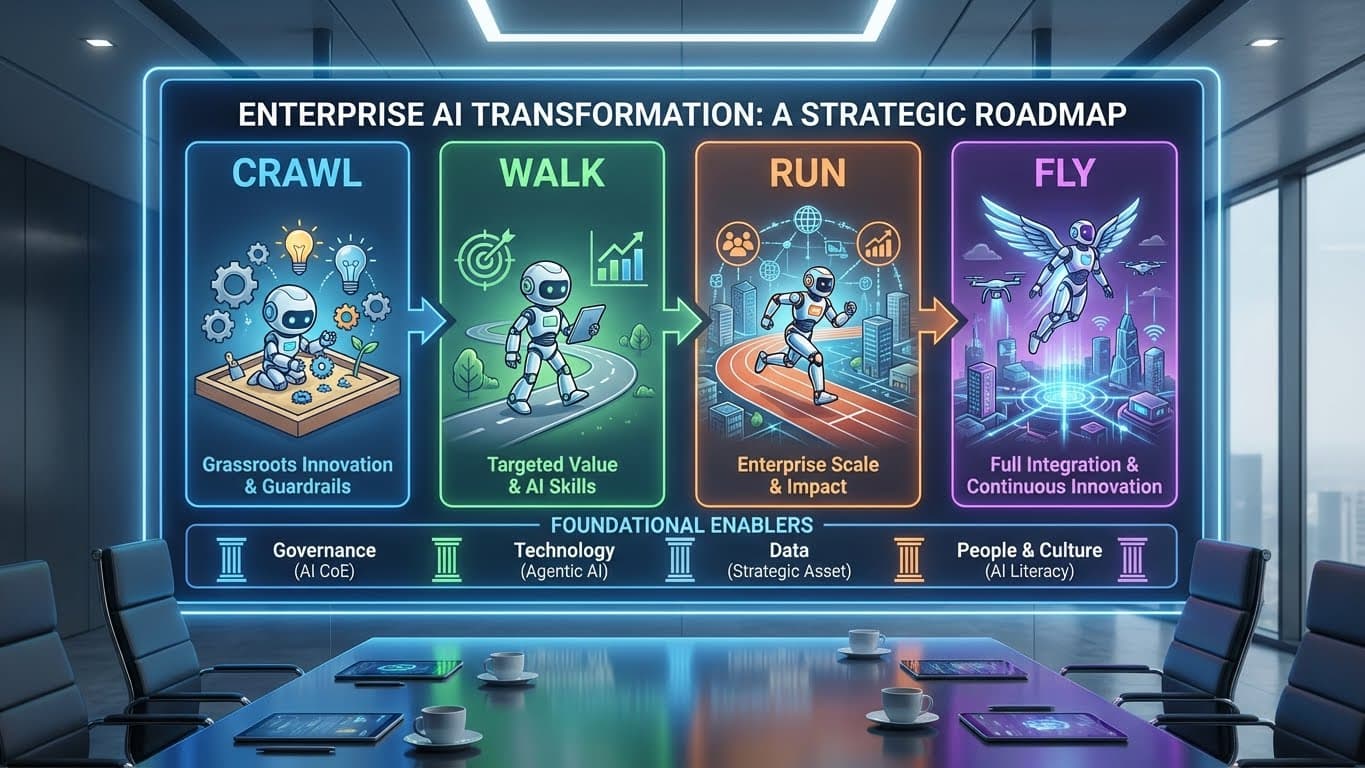
AI ArchitectureProduct/UIGovernance
Strategic roadmap infographic showing four AI maturity stages: Crawl (grassroots innovation with governance guardrails), Walk (targeted value delivery and AI skills development), Run (enterprise scale and measurable impact), and Fly (full integration with continuous innovation). Foundation shows four enablers: Governance (AI CoE), Technology (Agentic AI), Data (Strategic Asset), People & Culture (AI Literacy)
Infographics

Enterprise AI Transformation: Crawl, Walk, Run, Fly

A strategic roadmap for enterprise AI adoption following the Crawl-Walk-Run-Fly maturity model. Shows progression from grassroots innovation and guardrails, through targeted value delivery and skill-building, to enterprise-scale impact, and ultimately full integration with continuous innovation.
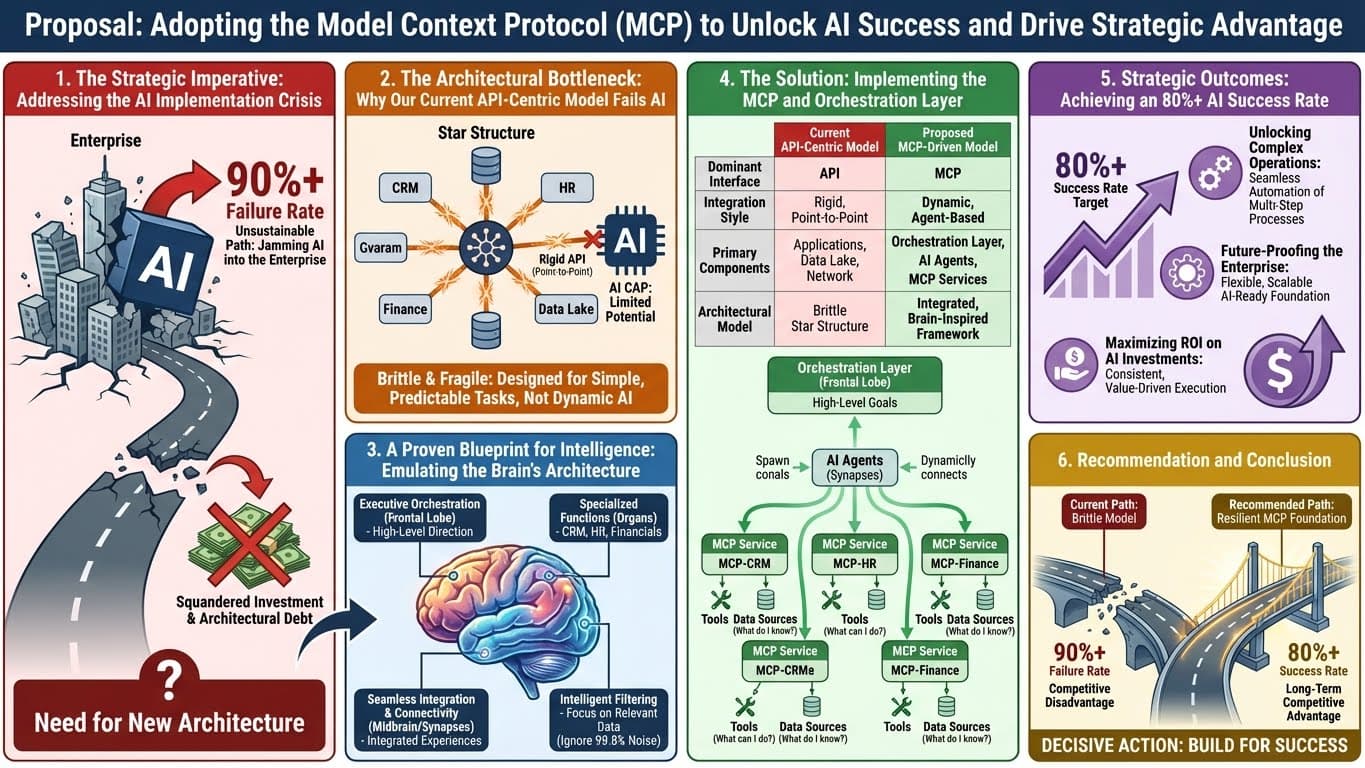
AI ArchitectureGovernanceProduct/UI
Proposal infographic with six sections: 1) Strategic imperative showing 90%+ AI failure rate, 2) Architectural bottleneck of rigid API star structure limiting AI capability, 3) Brain-inspired blueprint with frontal lobe orchestration and specialized organs, 4) MCP solution with orchestration layer and dynamic agent connections, 5) Strategic outcomes of 80%+ success rate and future-proofing, 6) Recommendation showing current brittle path vs resilient MCP foundation
Infographics

MCP Adoption Proposal: From 90% Failure to 80% Success

A comprehensive proposal infographic making the case for adopting Model Context Protocol (MCP) to address enterprise AI's 90%+ failure rate. Contrasts current brittle API-centric architecture with proposed MCP-driven orchestration layer, showing path to 80%+ AI success rate through brain-inspired architecture.
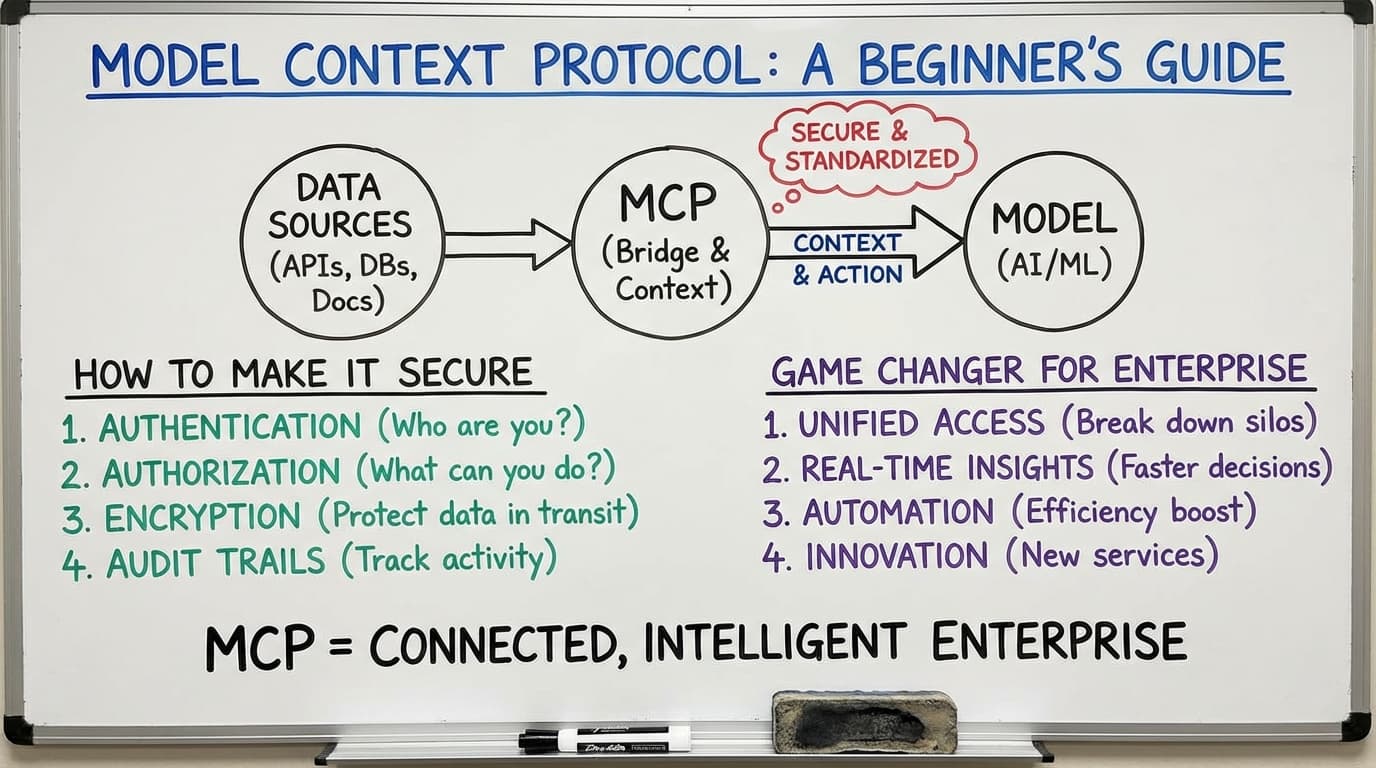
MCPAI ArchitectureAgents+1
Whiteboard diagram showing MCP as a bridge between data sources and AI models, with security features (authentication, authorization, encryption, audit trails) and enterprise benefits (unified access, real-time insights, automation, innovation)
Whiteboards

Model Context Protocol: A Beginner's Guide

An introductory guide to MCP explaining how it creates a secure, standardized bridge between AI models and data sources. Covers security fundamentals (authentication, authorization, encryption, audit trails) and enterprise benefits (unified access, real-time insights, automation, innovation).

MCPAI ArchitectureSecurity/IAM+1
Whiteboard diagram showing RAG workflow with user query flowing through retriever to relevant context to LLM generator for augmented answer. Includes three strategy phases: pre-retrieval (query expansion, rewriting, knowledge graph), retrieval (dense embeddings, sparse BM25, hybrid), and post-retrieval (context reranking, summarization, filtering)
Whiteboards

RAG Strategies: Pre-Retrieval, Retrieval, and Post-Retrieval

A detailed technical whiteboard covering the three phases of RAG optimization: pre-retrieval techniques (query expansion, rewriting, knowledge graph enrichment), retrieval methods (dense embeddings, sparse BM25, hybrid approaches), and post-retrieval refinements (context reranking, summarization, filtering).

RAGAI ArchitecturePatterns