Context
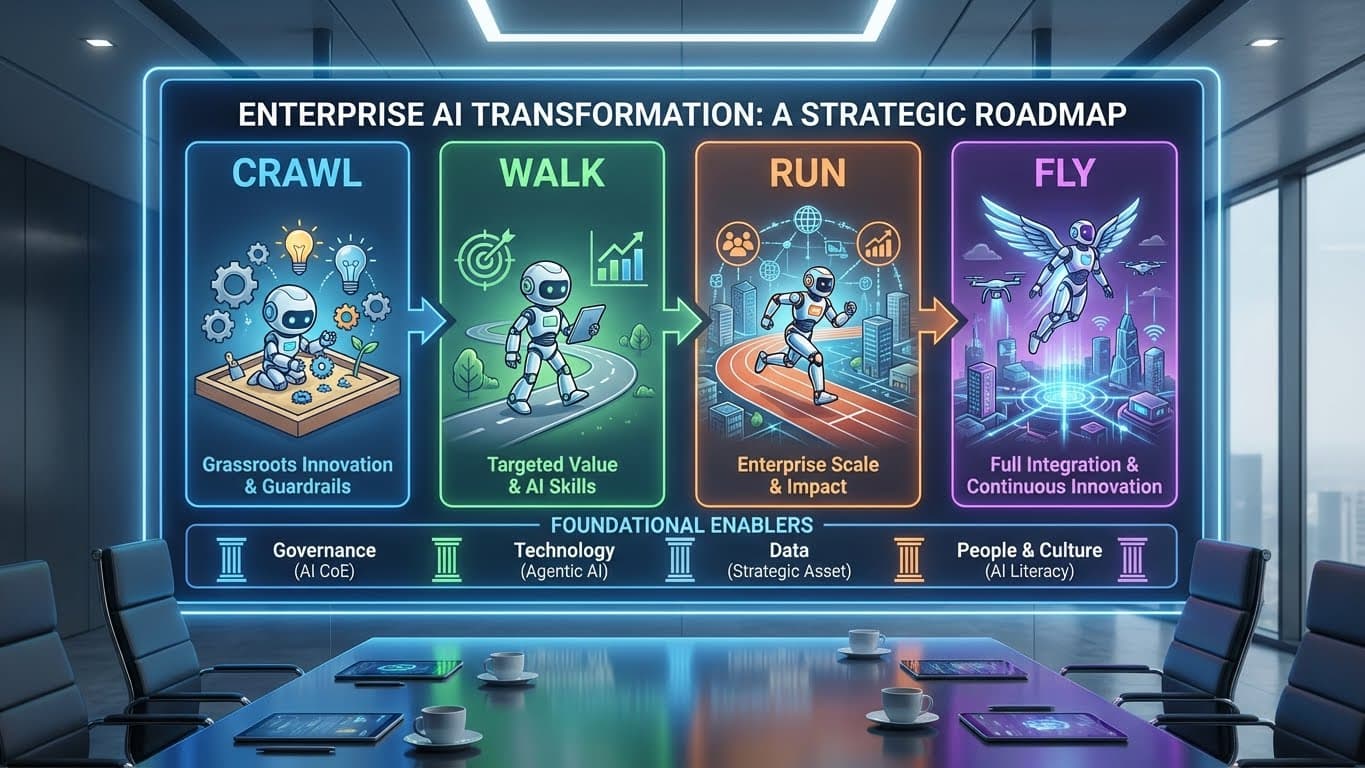
Most enterprise AI transformations fail not because of technology, but because of unrealistic expectations and poor sequencing. Organizations try to "Run" before they "Crawl"—deploying AI at scale without establishing governance, building skills, or validating use cases.
This roadmap provides a realistic maturity model based on observing successful (and failed) AI transformations across industries. The Crawl-Walk-Run-Fly framework gives leadership a mental model for pacing investment and setting expectations.
When to Use This Visual
Ideal for:
- Board presentations on AI strategy
- Multi-year AI transformation planning
- Executive workshops on AI maturity
- Justifying phased investment approaches
Target Audience:
- C-suite executives setting AI strategy
- Transformation leaders planning multi-year initiatives
- Board members evaluating AI investments
- Strategy consultants advising on AI adoption
Stage 1: Crawl (Grassroots Innovation & Guardrails)
Objective: Build organizational muscle, validate use cases, establish governance.
What it looks like:
- Small teams experimenting with AI tools (ChatGPT, GitHub Copilot, internal prototypes)
- AI Center of Excellence (CoE) established to set guidelines
- Governance guardrails in place (data privacy, security baselines, ethical use policies)
- Focus on learning, not scaling
Key activities:
- Run proof-of-concepts in low-risk domains
- Document lessons learned
- Build internal AI literacy through training
- Establish approval processes for AI tools
Duration: 3-6 months
Success metric: 5-10 validated use cases, governance framework in place, org understands AI capabilities and limits.
Common mistake: Skipping governance because "it slows us down." Guardrails prevent disasters later.
Stage 2: Walk (Targeted Value & AI Skills)
Objective: Deliver measurable value, build repeatable patterns, grow AI capabilities.
What it looks like:
- Targeted AI deployments in high-value areas (customer support, sales enablement, code generation)
- Cross-functional AI teams (data scientists, ML engineers, product managers)
- Investment in AI infrastructure (vector databases, MLOps, observability)
- Skill-building programs: Training engineers, upskilling domain experts
Key activities:
- Deploy 3-5 production AI features
- Measure ROI on AI investments
- Establish ML engineering best practices
- Create reusable AI components (e.g., RAG pipeline templates)
Duration: 6-12 months
Success metric: Measurable business impact (cost savings, revenue increase, productivity gains), AI literacy across teams.
Common mistake: Building one-off AI solutions without reusable patterns. This creates technical debt.
Stage 3: Run (Enterprise Scale & Impact)
Objective: Systematically deploy AI across the organization, measure impact at scale.
What it looks like:
- AI embedded in core business processes (sales forecasting, supply chain optimization, customer experience)
- Centralized AI platform with self-service capabilities
- Agentic AI systems handling complex multi-step workflows
- Data treated as a strategic asset (data governance, quality, access controls)
Key activities:
- Scale successful pilots to enterprise-wide deployment
- Build AI platform capabilities (shared infrastructure, model registry, observability)
- Implement robust monitoring and incident response for AI systems
- Expand AI use cases across departments
Duration: 12-24 months
Success metric: AI contributing to top-line revenue or bottom-line cost savings, multiple teams shipping AI features independently.
Common mistake: Scaling too fast without operational rigor. AI at scale requires robust monitoring, incident response, and governance.
Stage 4: Fly (Full Integration & Continuous Innovation)
Objective: AI as core competency, continuous innovation, competitive advantage.
What it looks like:
- AI embedded in every critical business process
- Continuous experimentation with new AI capabilities (new models, techniques, architectures)
- AI-native product features (differentiated customer experiences powered by AI)
- Culture of AI literacy: Engineers, product managers, and business leaders fluent in AI possibilities
Key activities:
- Build proprietary AI capabilities (fine-tuned models, custom architectures)
- Launch AI-powered products and services
- Establish feedback loops for continuous model improvement
- Contribute to AI research and public framework development
Duration: 24+ months (ongoing)
Success metric: AI as a competitive moat, measurable market differentiation, AI innovation culture.
Common mistake: Declaring victory and stopping investment. AI is a continuous journey—models improve, techniques evolve, competitors innovate.
Foundational Enablers (Required at Every Stage)
1. Governance (AI CoE)
- Crawl: Set policies, establish CoE
- Walk: Enforce policies, provide templates
- Run: Self-service governance tooling
- Fly: Governance as enabler, not blocker
2. Technology (Agentic AI)
- Crawl: Experiment with GenAI tools
- Walk: Build internal AI capabilities
- Run: Deploy agentic AI systems
- Fly: AI-native architecture
3. Data (Strategic Asset)
- Crawl: Identify critical datasets
- Walk: Build data access patterns
- Run: Data governance at scale
- Fly: Data as competitive advantage
4. People & Culture (AI Literacy)
- Crawl: Executive education
- Walk: Team training programs
- Run: Org-wide AI fluency
- Fly: AI-native workforce
How Long Does This Take?
Realistic timeline: 2-4 years from Crawl to Fly.
Accelerators:
- Executive sponsorship and clear strategy
- Existing data infrastructure
- Strong engineering culture
- Willingness to invest in governance upfront
Decelerators:
- Legacy systems and technical debt
- Siloed data and lack of access controls
- Resistance to change ("we've always done it this way")
- Skipping governance in favor of speed
Related Frameworks
- AI Maturity Models: Compare with Gartner, McKinsey, or industry-specific frameworks
- Digital Transformation Playbooks: How AI fits into broader digital strategy
- Change Management: Org change patterns for technology adoption