Context
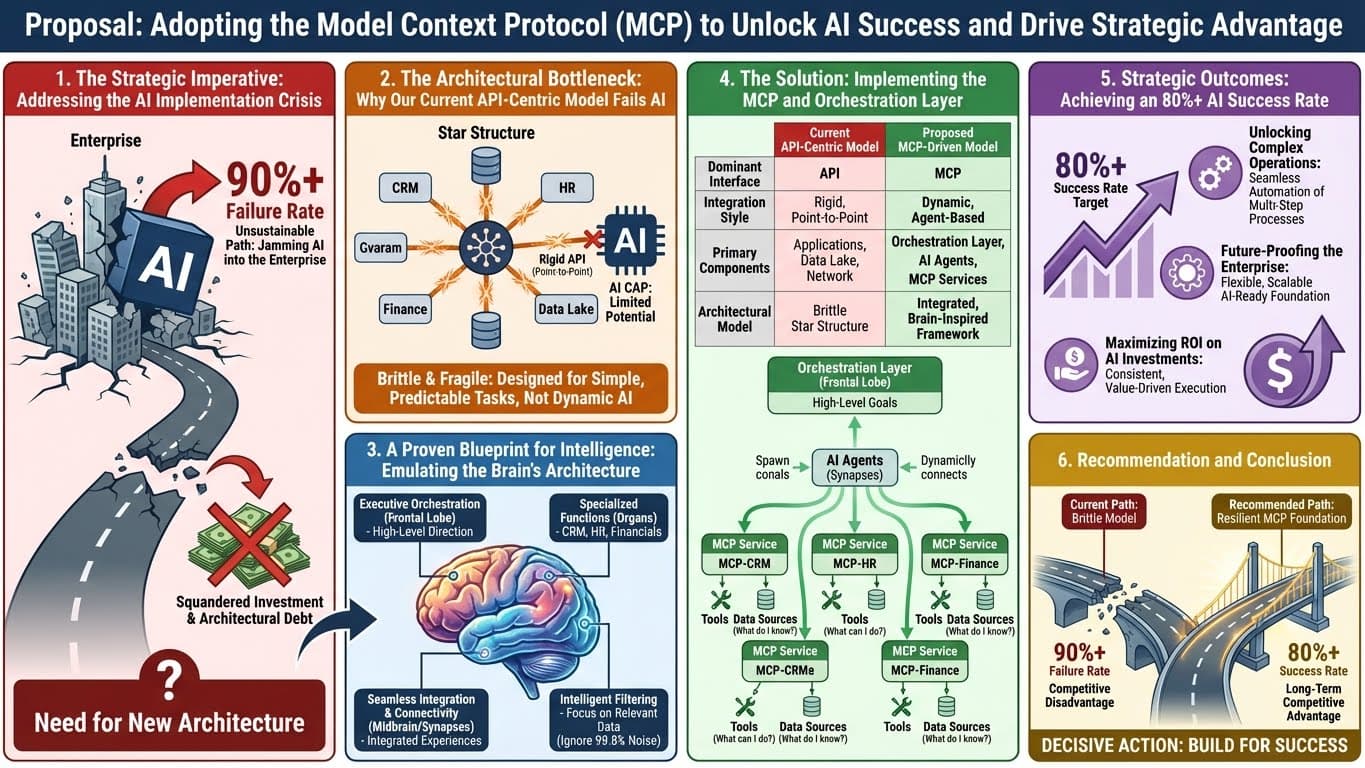
This proposal emerged from observing a pattern: enterprises investing heavily in AI, yet seeing 90%+ of initiatives fail to reach production. The root cause isn't lack of AI capability—it's architectural brittleness.
The visual makes the case that current API-centric integration patterns create a "star structure" where every system connects directly to the AI model. This works for simple tasks but breaks down when AI needs to orchestrate complex, multi-step workflows.
MCP solves this by introducing an orchestration layer that mimics how the human brain coordinates specialized functions.
When to Use This Visual
Ideal for:
- Executive presentations seeking MCP investment approval
- Board meetings discussing AI strategy
- Architecture review boards evaluating MCP adoption
- Vendor evaluations (build vs. buy for MCP infrastructure)
Target Audience:
- CIOs and CTOs making architecture decisions
- CFOs evaluating AI ROI
- Board members approving multi-year AI investments
- Enterprise architects planning transformation initiatives
Section 1: The Strategic Imperative
Problem: 90%+ AI failure rate in enterprises.
Why it matters:
- Squandered investment: Millions spent on AI initiatives that never ship
- Architectural debt: One-off integrations that can't scale
- Lost competitive advantage: Competitors who solve this will win
The unsustainable path: "Jamming AI into the enterprise" through point-to-point integrations creates fragility. Each new AI feature requires custom plumbing. As complexity grows, the system collapses under its own weight.
Key insight: The problem isn't the AI models—it's the integration architecture.
Section 2: The Architectural Bottleneck
Current state: API-centric star structure.
How it works (or doesn't):
- CRM, HR, Finance, Gyaros, Data Lake all connect directly to the AI model via APIs
- Every connection is rigid and point-to-point
- The AI model has limited capability because it's designed for simple, predictable tasks
Why it fails:
- Brittle: Any change to a system breaks the integration
- Not scalable: Adding a new system requires re-engineering all integrations
- Designed for simple tasks: Works for "fetch data from CRM" but fails for "coordinate onboarding across HR, IT, and Facilities"
Diagram insight: The "star structure" visual immediately shows the problem—every spoke is a fragile point of failure.
Section 3: A Proven Blueprint for Intelligence
Inspiration: The human brain.
How the brain works:
- Executive orchestration (frontal lobe): High-level direction and goal-setting
- Specialized functions (organs): CRM, HR, Financials each serve a specific role
- Seamless integration: The brain's "midbrain/synapses" coordinate signals between specialized functions
- Intelligent filtering: The brain ignores 99% of sensory input, focusing only on relevant signals
Key insight: The brain doesn't have a "star structure"—it has an orchestration layer that dynamically coordinates specialized components.
Translation to AI: MCP provides the "midbrain" that coordinates AI agents (frontal lobe) with enterprise systems (specialized organs).
Section 4: The Solution - MCP & Orchestration Layer
Proposed architecture:
Current vs. Proposed
| Aspect | Current (API-Centric) | Proposed (MCP-Driven) | |--------|----------------------|----------------------| | Dominant Interface | API (rigid, point-to-point) | MCP (dynamic, agent-based) | | Integration Style | Rigid, point-to-point | Dynamic, agent-based | | Primary Components | Applications, Data Lake, Network | Orchestration Layer, AI Agents, MCP Services | | Architectural Model | Brittle Star Structure | Brain-Inspired Framework |
How it works:
-
Orchestration Layer (Frontal Lobe): High-level goals and coordination
- Example: "Onboard new employee"
-
AI Agents (Synapses): Spawned dynamically by the orchestration layer
- Example: Onboarding agent spawns sub-agents for HR, IT, Facilities
-
MCP Services: Standardized interfaces to enterprise systems
- MCP-CRM: Tools and data sources for customer data
- MCP-HR: Tools and data sources for employee data
- MCP-Finance: Tools and data sources for financial data
Key innovation: The orchestration layer spawns agents dynamically based on the goal. No rigid connections—agents connect to MCP services as needed.
Section 5: Strategic Outcomes
1. Unlocking Complex Operations (80%+ Success Rate Target)
Current: AI can handle simple, single-system tasks ("fetch customer record")
With MCP: AI can handle multi-step, cross-system workflows:
- "Onboard new employee" → Coordinate HR (provisioning), IT (accounts), Facilities (desk assignment)
- "Close the quarter" → Aggregate Finance (revenue), Sales (pipeline), Operations (costs)
Result: Seamless automation of multi-step processes that were previously too complex.
2. Future-Proofing the Enterprise
Current: Brittle architecture requires re-engineering with every change
With MCP: Flexible, scalable AI-ready foundation:
- New systems plug into MCP services (no rewiring)
- New AI capabilities (new models, techniques) work with existing MCP infrastructure
- Standards-based architecture reduces vendor lock-in
Result: Organization can adopt new AI innovations without rearchitecting.
3. Maximizing ROI on AI Investments
Current: Inconsistent, ad-hoc AI deployments with unpredictable value
With MCP: Consistent, value-driven execution:
- Reusable MCP services amortize integration costs
- Faster time-to-value for new AI features
- Measurable ROI through standardized metrics
Result: AI investments pay back faster and more predictably.
Section 6: Recommendation and Conclusion
Current Path: Brittle model → 90%+ failure rate → Competitive disadvantage
Recommended Path: Resilient MCP foundation → 80%+ success rate → Long-term competitive advantage
Call to action: DECISIVE ACTION: BUILD FOR SUCCESS
The choice is clear:
- Continue with the current approach → watch competitors who adopt MCP pull ahead
- Adopt MCP now → build the foundation for AI-driven competitive advantage
Implementation Considerations
Phased approach:
- Phase 1 (3 months): Pilot MCP with 2-3 high-value use cases
- Phase 2 (6 months): Build core MCP infrastructure and onboard 5-10 systems
- Phase 3 (12 months): Scale to enterprise-wide MCP adoption
Investment required:
- MCP infrastructure (servers, orchestration layer)
- MCP service development (wrappers for existing systems)
- Training and change management
Expected ROI: 3-5x return within 18 months through improved AI success rates and reduced integration costs.
Related Concepts
- Agent Orchestration Patterns: How agents coordinate via MCP
- MCP Security Model: Authentication, authorization, audit trails
- Brain-Inspired AI Architecture: Mimicking human cognition in enterprise systems