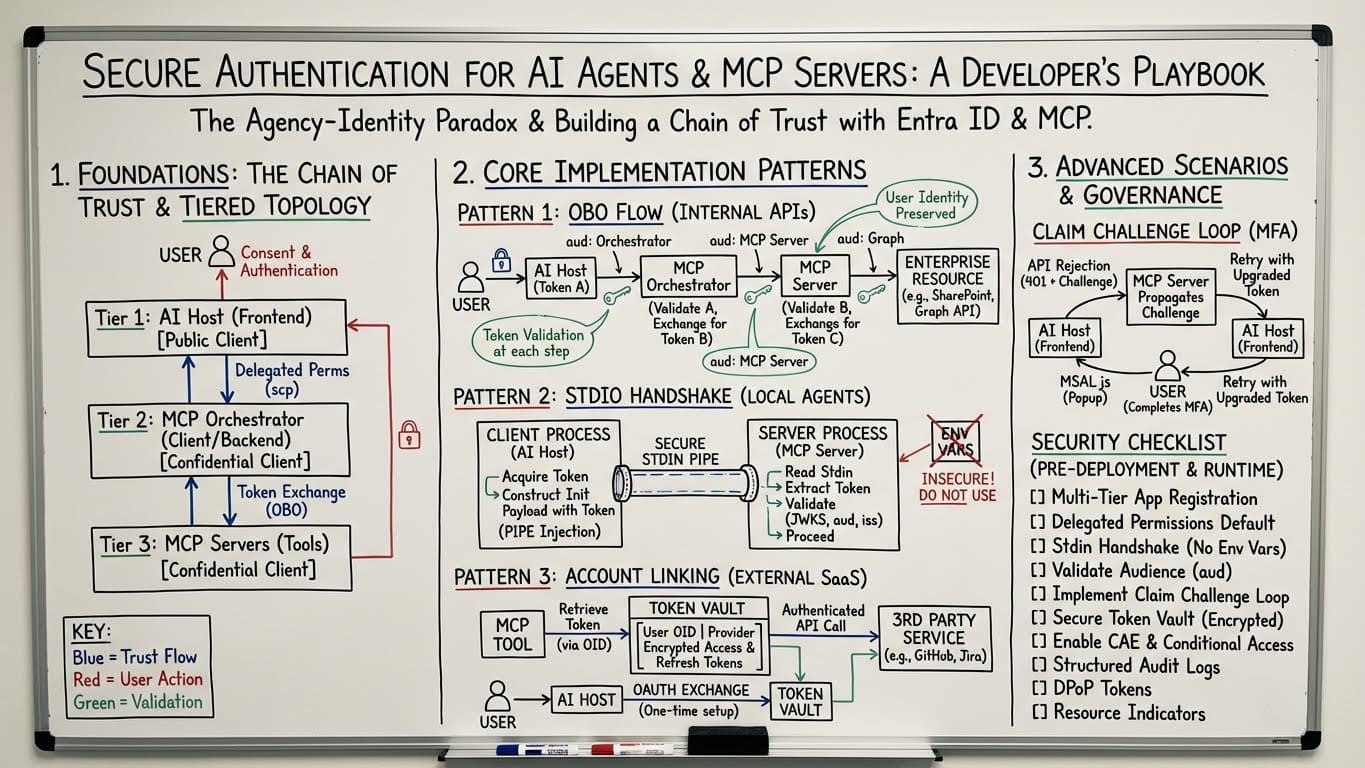
Context
AI agents and MCP servers introduce a new authentication challenge: how do you securely delegate permissions to autonomous systems that act on behalf of users?
Traditional OAuth works for user-to-service authentication, but agents need service-to-service authentication with user context preserved. This is the agency-identity paradox.
This playbook emerged from building production AI agent systems and encountering every authentication pitfall. It codifies the patterns that work.
When to Use This Visual
Ideal for:
- Security architecture reviews for AI agent systems
- MCP server implementation planning
- Penetration testing and security audits
- Compliance documentation (SOC2, ISO 27001)
Target Audience:
- Security engineers designing AI authentication
- Backend engineers building MCP servers
- DevSecOps teams securing AI deployments
- Compliance officers evaluating AI systems
Section 1: Foundations - The Chain of Trust & Tiered Topology
The Agency-Identity Paradox
Problem: AI agents need to:
- Act autonomously (agency)
- Preserve user identity and permissions (identity)
- Access multiple backend systems (distributed trust)
Tension: How do you give an agent permission to act on behalf of a user without giving it full user permissions?
Solution: Delegated permissions + tiered trust topology.
Tiered Trust Topology
Three tiers:
Tier 1: AI Host (Frontend) - Public Client
- User-facing interface (web app, IDE plugin, chatbot)
- User consents & authenticates here
- Trust level: User trusts this, delegates permissions
Tier 2: MCP Orchestrator (Client/Backend) - Confidential Client
- Coordinates agents and MCP servers
- Receives delegated permissions from Tier 1
- Trust level: Operates on behalf of user with scoped permissions
Tier 3: MCP Servers (Tools) - Confidential Client
- Access enterprise resources (e.g., SharePoint, GitHub, Jira)
- Receive tokens from Tier 2 (not directly from user)
- Trust level: Least privileged access, specific to resource
Key insight: User identity flows down the chain (Tier 1 → 2 → 3), but tokens are exchanged at each tier with reduced scope.
Visual Elements
Key:
- Blue arrows = Trust flow (user delegates to AI host, AI host delegates to orchestrator, etc.)
- Red arrows = User action (consent, authentication)
- Green arrows = Validation (token verification, permission checks)
Section 2: Core Implementation Patterns
Pattern 1: OBO Flow (Internal APIs)
Use case: AI orchestrator calling enterprise APIs on behalf of user.
How it works:
-
User → Authenticates with AI Host (Frontend)
- Consent & Authentication
- Token A issued
-
AI Host → Calls MCP Orchestrator (Backend)
- Passes Token A
- MCP Orchestrator validates Token A
-
MCP Orchestrator → Exchanges Token A for Token B
- Token exchange (OBO - OAuth on-behalf-of)
- Token B is scoped to specific MCP Server
-
MCP Orchestrator → Calls MCP Server (Tool)
- Validates Token B
- Exchanges for Token C (scoped to enterprise resource like SharePoint Graph API)
-
MCP Server → Calls Enterprise Resource (e.g., SharePoint)
- Validates Token C
- Returns data
Key properties:
- User identity preserved at every step (Token A → B → C all contain user claims)
- Delegated permissions (each token has reduced scope)
- Auditable (logs show user → orchestrator → server → resource)
When to use: Internal APIs where you control both client and server.
Pattern 2: STDIO Handshake (Local Agents)
Use case: AI agents running locally (e.g., IDE plugins, CLI tools) accessing MCP servers.
How it works:
Client Process (AI Host):
- Acquire Token (via OAuth, browser flow)
- Construct Init Payload with Token
- Send payload via STDIO (secure stdin pipe injection)
Server Process (MCP Server):
- Read Stdin
- Extract Token
- Validate Token (JWKS, aud, iss)
- Proceed with MCP operations
Key innovation: STDIO pipe is inherently secure (process-local, not network-exposed).
Security considerations:
- Do NOT use environment variables (easily leaked, visible in process lists)
- INSECURE! Env vars are a common attack vector
When to use: Local agents (IDE plugins, CLI tools) with MCP servers running on the same machine or trusted network.
Pattern 3: Account Linking (External SaaS)
Use case: Linking user's third-party accounts (GitHub, Jira, Google) to AI agents.
How it works:
-
User initiates OAuth exchange (one-time setup)
- Grants AI access to external service
-
MCP Tool retrieves token via OAuth ID (OID)
- Token stored in Token Vault (encrypted, access-controlled)
-
MCP Tool makes authenticated API call to 3rd Party Service
- Token passed in Authorization header
Token Vault requirements:
- Encrypted: Tokens at rest are encrypted
- Access-controlled: Only authorized MCP tools can retrieve
- Refresh tokens: Automatically refresh expired tokens
When to use: Integrating with external SaaS (GitHub, Jira, Salesforce, etc.)
Section 3: Advanced Scenarios & Governance
Claim Challenge Loop (MFA)
Problem: User needs to perform high-risk action (e.g., delete data, change permissions).
Solution: Step-up authentication via claim challenge.
How it works:
-
MCP Server rejects API call (401 + Challenge)
- Response includes required claim (e.g., MFA authentication)
-
AI Host (Frontend) receives challenge
- Initiates MFA flow (MSAL.js popup)
-
User completes MFA
- Upgraded token issued with MFA claim
-
AI Host retries with upgraded token
- MCP Server validates MFA claim
- Proceeds with high-risk action
When to use:
- High-risk operations (delete, permission changes, financial transactions)
- Compliance requirements (SOC2, HIPAA, PCI-DSS)
Section 4: Security Checklist
Pre-Deployment (Design & Configuration)
✅ Multi-Tier App Registration
- Separate registrations for AI Host (public client), MCP Orchestrator (confidential client), MCP Servers (confidential clients)
✅ Delegated Permissions Default
- Use delegated permissions (scp), NOT application permissions (roles)
- Application permissions grant tenant-wide access (too broad)
✅ Stdin Handshake (No Env Vars)
- Use STDIO for local authentication
- Never store tokens in environment variables
✅ Validate Audience (aud)
- Every server validates
audclaim matches expected audience - Prevents token reuse across services
✅ Implement Claim Challenge Loop
- Support step-up authentication for high-risk actions
- Graceful MFA handling
✅ Secure Token Vault (Encrypted)
- Tokens at rest are encrypted (AES-256 or equivalent)
- Access control: only authorized services can retrieve
✅ Enable CAE & Conditional Access
- Continuous Access Evaluation (CAE) for real-time revocation
- Conditional Access Policies for context-aware authentication (location, device, risk)
Runtime (Monitoring & Operations)
✅ Structured Audit Logs
- Log every authentication event (who, what, when, where)
- Include: user ID, requested scopes, granted scopes, IP, timestamp, result (success/failure)
✅ DPoP Tokens
- Demonstrate Proof-of-Possession (DPoP) tokens for enhanced security
- Binds token to client instance, prevents token theft
✅ Resource Indicators
- Specify target resource in token requests
- Improves auditability and security (token scoped to specific resource)
Common Pitfalls
❌ Using Application Permissions Instead of Delegated
Problem: Application permissions grant tenant-wide access, not scoped to user.
Impact: Agent can access all user data, not just the authenticated user's data.
Fix: Use delegated permissions (scp claim), not application permissions (roles claim).
❌ Storing Tokens in Environment Variables
Problem: Env vars are visible in process lists, logs, crash dumps.
Impact: Token leakage risk.
Fix: Use STDIO pipes or secure vaults.
❌ Skipping Audience Validation
Problem: Tokens intended for Service A can be used for Service B.
Impact: Privilege escalation, unauthorized access.
Fix: Every service validates aud claim.
❌ No Claim Challenge Loop
Problem: Can't handle step-up authentication for high-risk actions.
Impact: Either block all high-risk actions or allow without MFA (security vs. usability trade-off).
Fix: Implement claim challenge loop with MFA support.
❌ Insufficient Audit Logging
Problem: Can't trace security incidents or compliance violations.
Impact: Fails security audits, can't investigate breaches.
Fix: Structured logs with user ID, scopes, timestamps, results.
Related Patterns
- OAuth 2.0 On-Behalf-Of Flow: Token exchange for service-to-service auth
- Continuous Access Evaluation (CAE): Real-time token revocation
- Zero Trust Architecture: Verify every request, never trust implicitly
- Least Privilege Access: Grant minimum permissions required