Context
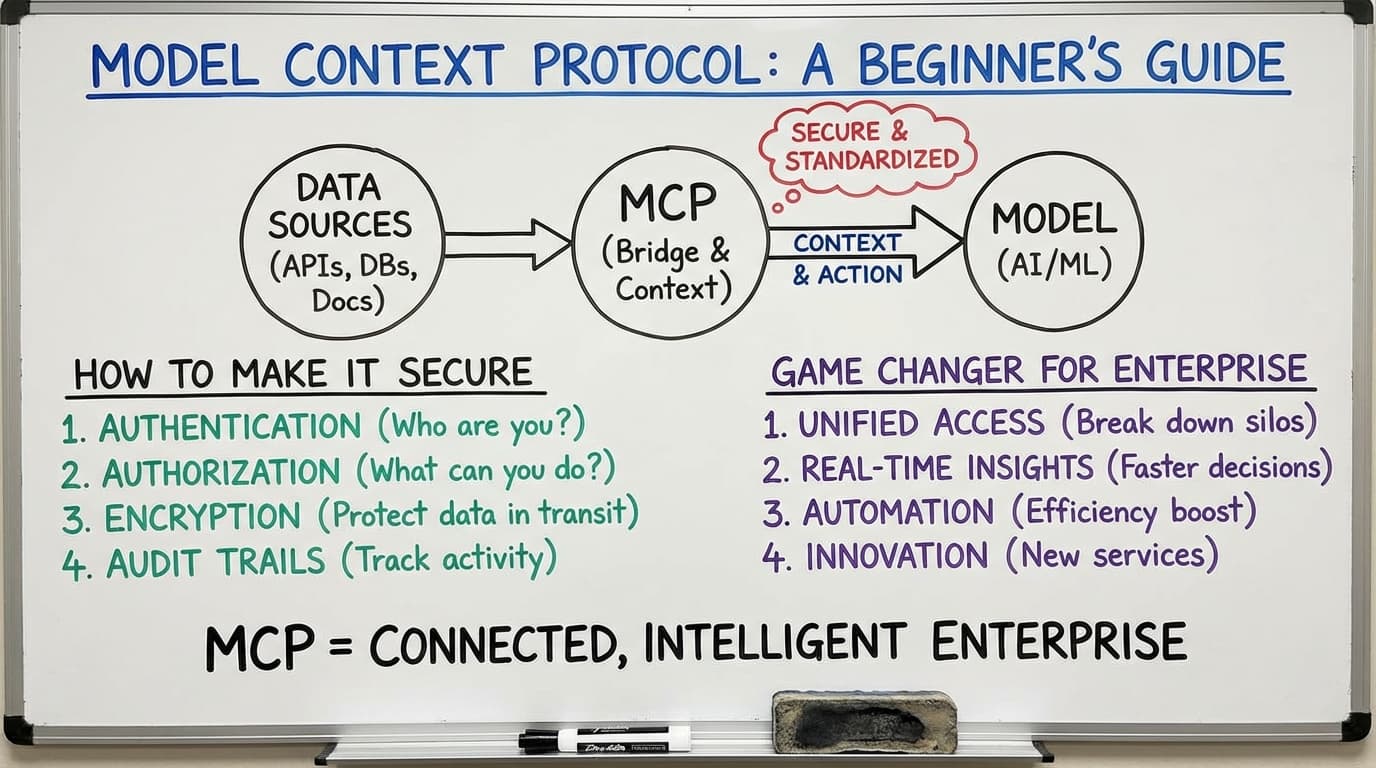
The Model Context Protocol (MCP) is often explained in technical terms that lose business stakeholders. This visual reframes MCP as a business enabler: a standardized way to connect AI models to enterprise data securely.
The "bridge" metaphor is intentional—MCP doesn't replace your existing systems, it connects them. It's infrastructure, not a product.
When to Use This Visual
Ideal for:
- Executive presentations on AI infrastructure
- Security/compliance reviews for AI initiatives
- Cross-functional workshops explaining AI architecture
- Vendor evaluations (does this tool support MCP?)
Target Audience:
- CIOs and CTOs evaluating AI platforms
- Security and compliance teams
- Business stakeholders funding AI projects
- Product leaders planning AI features
Why MCP Matters for Enterprises
Problem: The Star Structure Anti-Pattern
Without MCP, every AI integration is a point-to-point connection:
- CRM → AI Model
- HR System → AI Model
- Finance Database → AI Model
- Data Lake → AI Model
This creates:
- N×M integration complexity (every model × every data source)
- Security nightmares (credentials scattered everywhere)
- No standardization (each integration reinvents the wheel)
Solution: MCP as the Hub
MCP centralizes context exchange:
- Data sources → MCP → AI Models
- Single security model (authenticate once, use everywhere)
- Standardized protocols (same interface for all integrations)
Security: Non-Negotiable
The visual emphasizes four security pillars:
-
Authentication: "Who are you?"
- Verify identity before granting access
- Support SSO, OAuth, API keys
-
Authorization: "What can you do?"
- Permission-based access control
- Respect existing data governance policies
-
Encryption: "Protect data in transit"
- TLS/SSL for all connections
- No plaintext credentials
-
Audit Trails: "Track activity"
- Log every access for compliance
- Enable security incident investigation
Critical insight: MCP doesn't weaken security—it centralizes it, making it easier to enforce consistently.
Enterprise Game Changers
1. Unified Access (Break Down Silos)
Instead of AI models accessing data through dozens of custom connectors, they use MCP. This means:
- Faster time-to-value for new AI features
- Consistent data access patterns
- Reduced integration maintenance burden
2. Real-Time Insights (Faster Decisions)
MCP enables AI models to query live data, not stale snapshots:
- Customer support AI sees current ticket status
- Financial AI analyzes up-to-the-minute metrics
- HR AI accesses real-time employee data
3. Automation (Efficiency Boost)
With standardized context, AI agents can orchestrate multi-step workflows:
- "Onboard new employee" → AI coordinates HR, IT, Facilities via MCP
- "Close the quarter" → AI pulls data from Finance, Sales, Operations
4. Innovation (New Services)
MCP makes it feasible to build AI features that were previously too complex:
- Cross-system analytics ("Compare sales performance vs. support ticket trends")
- Personalized experiences ("Recommend training based on employee's role, skills, and goals")
What MCP Is NOT
- ❌ Not a database: MCP doesn't store data, it provides access to existing data
- ❌ Not an AI model: MCP is infrastructure, not intelligence
- ❌ Not a replacement for APIs: It's a standard protocol that sits alongside REST, GraphQL, etc.
Related Concepts
- RAG with MCP: How MCP enables permission-aware retrieval
- Agent Orchestration with MCP: Multi-agent systems coordinating via MCP
- Security Patterns: Authentication flows and token management for MCP