Context
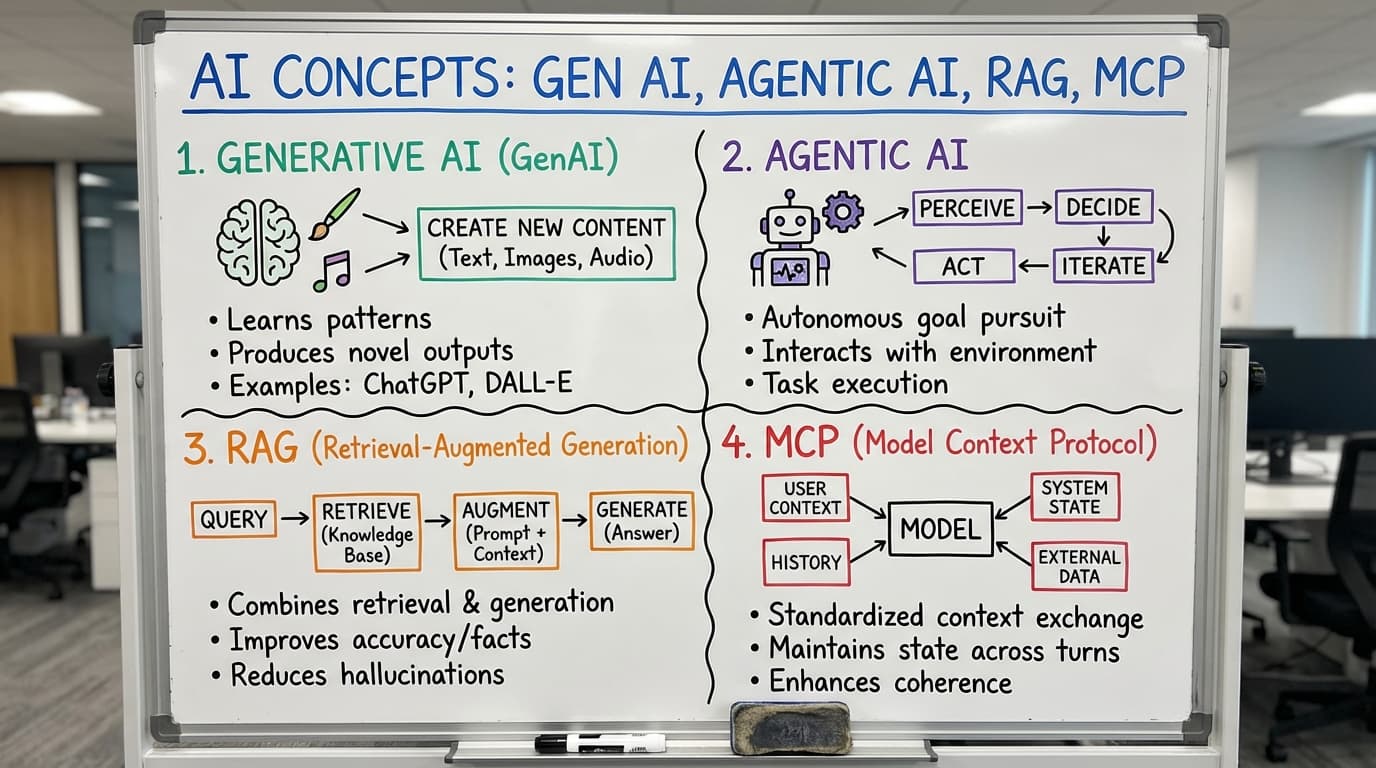
These four concepts—Generative AI, Agentic AI, RAG, and MCP—represent the building blocks of modern enterprise AI systems. Understanding how they interrelate is essential for architecting production AI applications.
This visual emerged from repeated conversations where teams confused these concepts or failed to see how they fit together. It's designed as a reference diagram you can share in architecture reviews or planning sessions.
When to Use This Visual
Ideal for:
- Technical architecture discussions
- Team alignment on AI strategy
- Training sessions for engineers moving into AI/ML roles
- Documentation for system design
Target Audience:
- Software engineers implementing AI features
- Solution architects designing AI systems
- Technical leads planning AI roadmaps
- Product managers with technical backgrounds
Deep Dive: How These Concepts Relate
Generative AI: The Foundation
Generative AI (GenAI) is the base layer—models like GPT-4, Claude, or DALL-E that can create new content. Examples: ChatGPT for text, DALL-E for images, GitHub Copilot for code.
Key characteristic: Learns patterns from training data, then produces novel outputs that match those patterns.
Agentic AI: Adding Autonomy
Agentic AI builds on GenAI by adding autonomous goal pursuit. Instead of responding to single prompts, agents:
- Perceive the environment
- Decide what action to take
- Act on that decision
- Iterate until the goal is achieved
Example: An AI assistant that doesn't just answer "How do I deploy this?" but actually writes the deployment script, tests it, fixes errors, and deploys.
RAG: Grounding in Reality
RAG (Retrieval-Augmented Generation) solves the hallucination problem by grounding GenAI responses in real data:
- Query comes from the user
- Retrieve relevant documents from a knowledge base
- Augment the prompt with retrieved context
- Generate a response based on actual facts
Why it matters: Reduces hallucinations, provides citations, works with proprietary/recent data.
MCP: The Glue
MCP (Model Context Protocol) standardizes how AI systems access context:
- User context (who is asking, their permissions, preferences)
- Conversation history (maintain state across turns)
- System state (what tools/resources are available)
- External data (APIs, databases, documents)
Why it matters: Without MCP, every AI integration is a one-off point-to-point connection. MCP creates a standard "language" for context exchange.
How They Work Together
In a production system, you'll often use all four:
- GenAI provides the core language/reasoning capability
- RAG grounds responses in your enterprise knowledge
- Agentic AI enables multi-step task execution
- MCP standardizes how agents access data and maintain context
Related Patterns
- Secure Enterprise RAG: Permission-aware retrieval patterns
- Agent Orchestration: Coordinating multiple agents toward a goal
- Context Window Engineering: Optimizing token usage with MCP