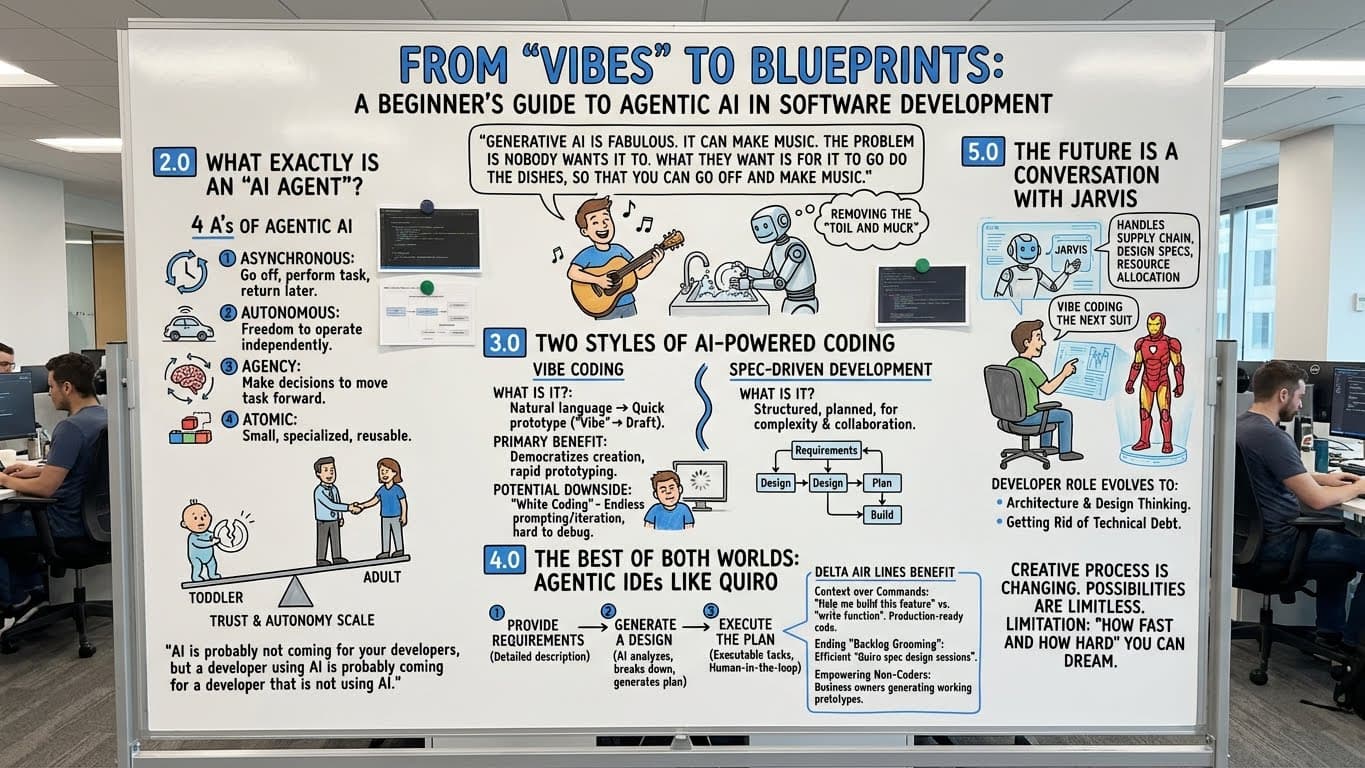
Context
"Agentic AI" is a buzzy term that means different things to different people. For software developers, the critical question is: How does this change how I build software?
This visual emerged from conversations with engineering teams confused about the hype. Some see AI as a threat ("is it coming for my job?"), others see it as overhyped ("it's just autocomplete"). The reality is nuanced.
Agentic AI enables two workflows:
- Vibe coding: Natural language → working prototype (great for exploration)
- Spec-driven development: Structured requirements → agentic planning → execution (great for complex systems)
Both are valuable. Knowing when to use each is the skill.
When to Use This Visual
Ideal for:
- Engineering team workshops on AI-assisted development
- Onboarding developers to agentic coding tools
- Architecture discussions about AI in the SDLC
- Product planning sessions exploring AI code generation
Target Audience:
- Software engineers evaluating AI coding tools
- Engineering managers planning AI adoption
- Product managers exploring AI-powered development
- Technical leads setting AI development standards
Section 2.0: What Exactly Is an "AI Agent"?
The 4 A's of Agentic AI:
1. Asynchronous
Go off, perform task, return later.
Unlike traditional functions that block execution, agents run independently and notify when done.
Example: "Deploy this feature" → agent goes off, runs tests, builds, deploys, reports back.
2. Autonomous
Freedom to operate independently.
Agents don't need hand-holding. They make micro-decisions to achieve the goal.
Example: "Fix the failing tests" → agent investigates root cause, modifies code, re-runs tests without asking permission at each step.
3. Agency
Make decisions to move task forward.
Agents evaluate options and choose paths, not just execute scripts.
Example: "Improve performance" → agent profiles code, identifies bottleneck, chooses optimization strategy (caching vs. algorithm change), implements.
4. Atomic
Small, specialized, reusable.
Agents handle well-defined tasks, not everything. Compose agents for complex workflows.
Example: One agent writes code, another runs tests, another handles deployment. Orchestration layer coordinates them.
Analogy: Agents are like specialized workers on an assembly line, not generalists trying to do everything.
Section 3.0: Two Styles of AI-Powered Coding
Vibe Coding
What is it? Natural language → quick prototype ("vibe" → draft)
How it works:
- Developer describes desired behavior in natural language
- AI generates working code
- Developer iterates with more prompts
Primary benefit: Democratizes creation
- Non-coders can build prototypes
- Rapid iteration on ideas
- Lowers barrier to experimentation
Example:
Prompt: "Build a React component that shows a user's profile with avatar, name, and bio"
→ AI generates component
→ "Add a follow button"
→ AI updates component
→ "Make the avatar circular"
→ AI refines styling
Potential downside: "White-coding"
- Endless prompting/iteration loop
- Hard to debug ("the AI wrote it, I don't understand it")
- Technical debt accumulation
When to use:
- Prototyping and exploration
- Learning new frameworks/languages
- Non-critical code paths
- Disposable experiments
Spec-Driven Development
What is it? Structured, planned, for complexity & collaboration
How it works:
- Requirements → Design → Plan → Build
- Agentic AI handles design and planning phases
- Human reviews and approves before execution
Primary benefit: Production-ready code
- Clear requirements upfront
- Architectural planning before implementation
- Collaboration-friendly (team reviews specs, not prompts)
Example (Delta Air Lines use case):
Context over Commands:
"Help me build this feature" vs. "Write function calculateRefund()"
Ending "Backlog Grooming":
- AI analyzes requirements, breaks into tasks, estimates complexity
- Efficient sprint planning without hours of manual spec sessions
Empowering Non-Coders:
- Business owners generate working prototypes from requirements
- Developers review, refine, productionize
When to use:
- Production systems
- Complex, multi-component features
- Team collaboration required
- Maintainability matters
Section 4.0: The Best of Both Worlds - Agentic IDEs Like Quiro
The promise: Combine vibe coding's speed with spec-driven development's structure.
How agentic IDEs work:
Step 1: PROVIDE REQUIREMENTS
- Developer describes what needs to be built (detailed description, not just a prompt)
Step 2: GENERATE A DESIGN
- AI analyzes requirements, breaks down components, suggests architecture
- Outputs a plan (not code yet)
Step 3: EXECUTE THE PLAN
- AI generates executable tasks (human-in-the-loop)
- Agentic workflow orchestrates implementation
Key innovation: Separation of concerns
- Design phase: AI proposes architecture → human reviews/approves
- Execution phase: AI implements approved design → human tests/deploys
Benefits:
- Vibe coding speed (AI generates plans quickly)
- Spec-driven rigor (human approval before execution)
- Avoids "white-coding" (clear design before implementation)
Section 5.0: The Future is a Conversation with Jarvis
Vision: Developers as architects, AI as implementation layer.
Example conversation:
Developer: "Jarvis, I need to deploy a new supply chain optimization feature."
Jarvis:
- Handles supply chain integration (APIs, data sources)
- Design specs (architecture, components, dependencies)
- Resource allocation (compute, storage, scaling)
- Vibe coding the "next suit" (prototyping UI, backend, ML models)
Developer role evolves:
- Architecture & design thinking: High-level decisions, trade-offs, constraints
- Getting rid of "technical debt": AI handles routine implementation, developer focuses on strategic code health
- Creative process is changing: Possibilities are limitless, limitation is "how fast and how hard you can ideate"
Not "AI replacing developers": AI removing toil, enabling higher-level thinking.
The Nuanced Reality
Generative AI is fabulous. It can make music.
But nobody wants it to make music for them—they want it to do the dishes so they can make music.
Translation for developers:
- AI shouldn't write your creative, high-value code
- AI should handle boilerplate, plumbing, repetitive tasks
- This frees you to focus on architecture, design, innovation
Key insight: "AI is probably not coming for your developers, but a developer using AI is probably coming for a developer that is not using AI."
Related Concepts
- Agent Orchestration: How to coordinate multiple specialized agents
- Prompt Engineering Patterns: Techniques for effective requirements specification
- Agentic Workflows: Designing multi-step agent collaborations
- AI-Assisted Code Review: Using AI to catch bugs, suggest improvements